

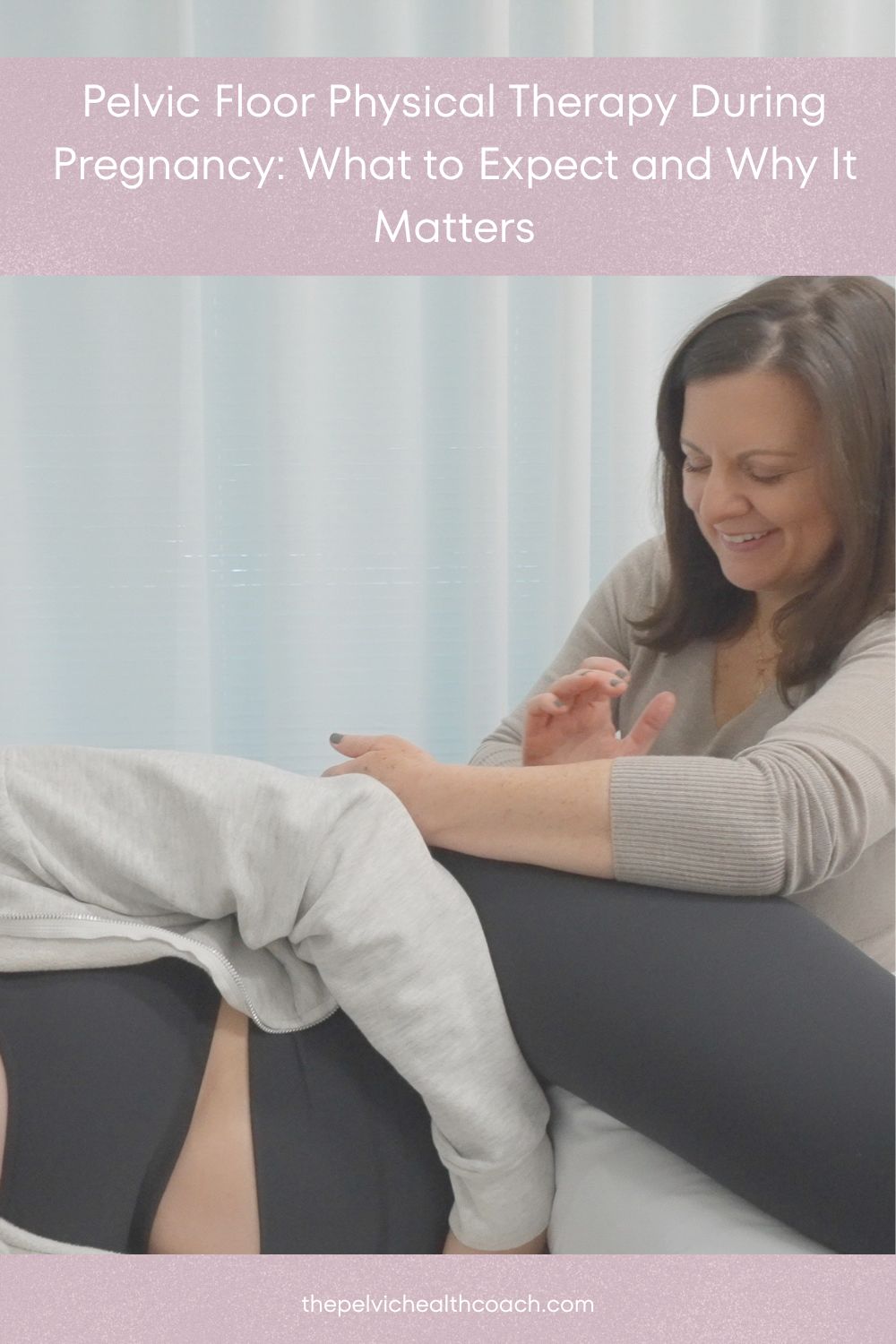
Most women don’t hear about pelvic floor physical therapy until after they’ve delivered. If they hear about it at all, it often comes up only after something has already gone wrong: leaking, pain, a difficult recovery.
But pregnancy is actually one of the best times to work with a pelvic health physical therapist. Not because something is wrong, but because so much is right around the corner.
Birth preparation, pelvic floor function, nervous system regulation, partner support, and the physical demands of labor are all things that can be addressed, practiced, and strengthened during pregnancy. The women who come in during this window tend to
feel more prepared, more confident, and more connected to what their body is doing. That matters enormously when labor begins.
This post explains what prenatal pelvic PT actually involves, what symptoms it can address, and what the birth preparation side of this work really looks like. It goes much deeper than most people expect.
What Changes in Your Body During Pregnancy
Pregnancy creates significant changes in the musculoskeletal system, many of which directly affect the pelvic floor, core, and how the body handles load and movement.
- Relaxin, a hormone that increases during pregnancy, loosens ligaments throughout the body to allow for the changes needed for This is helpful, but it also creates instability in the pelvis, SI joints, pubic symphysis, and hips.
- The growing uterus shifts the center of gravity forward, changing how the low back, pelvis, and hips have to work to maintain balance and movement.
- The pelvic floor carries increasing load across all three trimesters as the baby
- Breathing mechanics change as the diaphragm gets pushed upward, which affects core pressure management and pelvic floor function.
- Postural compensations develop as the body adapts. Some of these compensations create pain, tension, and dysfunction that does not have to be accepted as inevitable.
Many of the symptoms women chalk up to just part of pregnancy are actually things that respond well to treatment. You don’t have to white-knuckle your way through.
Common Pregnancy Symptoms Pelvic PT Can Help With
- Pelvic girdle pain and pubic symphysis discomfort
- Low back and SI joint pain
- Urinary leakage or urgency
- Constipation
- Pelvic heaviness or pressure
- Round ligament pain
- Rib pain related to breathing and postural changes
- Hip pain or difficulty with movement
- Difficulty sleeping comfortably due to hip or back pain
These are not minor inconveniences to push through. They are signals from your body that something can be improved, and addressing them during pregnancy sets you up for a healthier birth and postpartum recovery.
What a Prenatal Evaluation Looks Like at Pinnacle
Every appointment begins with a conversation. We want to understand your history, your symptoms, your goals, and what pregnancy has felt like for your body so far.
From there, a prenatal pelvic PT evaluation typically includes:
- A movement and postural assessment to look at how you stand, sit, and move, and where compensatory patterns are developing
- Breathing assessment to evaluate how the diaphragm, core, and pelvic floor are working together
- Hip and pelvis mobility assessment
- Discussion of your birth preferences and how we can support your preparation
Pelvic floor muscle assessment is also available as part of your evaluation, and it is always your choice. Some women want a clear picture of how their pelvic floor is functioning before birth; others prefer to start with external work and build from there. Both are completely valid approaches.
If an internal assessment feels right for you, it is gentle, guided entirely by your comfort, and informative in ways that external assessment alone cannot fully capture. If you’d prefer to learn how to check in with your own muscles at home, we can teach you exactly how to do that with awareness and breath. No internal exam required. We follow your lead, always.
Treatment from there is personalized. It may include manual therapy, alignment coaching, breathing and pressure management strategies, movement guidance, and a home program you can realistically fit into daily life.
Birth Preparation: Much More Than You Might Expect
This is where prenatal pelvic PT becomes something that genuinely changes the birth experience, not just the recovery.
Most women prepare for birth by packing a hospital bag. Very few receive guidance on how to actually prepare their body and mind for what labor involves. That gap is exactly what we work to fill.
Nervous System Preparation: Rest, Digest, and Let Go
Labor requires the body to move through powerful, intense sensations over a sustained period of time. The nervous system plays an enormous role in how this unfolds.
When the nervous system is in a chronic state of fight-or-flight, which is where most modern women spend much of their day, the pelvic floor holds tension, labor can progress more slowly, and pain becomes harder to manage. The body’s natural ability to open and release is inhibited.
We work intentionally on shifting into what’s often called rest and digest mode. In this parasympathetic state, the body can soften, open, and respond more effectively to the demands of labor.
In our sessions, this includes:
- Education on what fight-or-flight does to the pelvic floor and uterus during labor, and why creating calm matters
- Guided diaphragmatic breathing practices that down-regulate the nervous system and cue the pelvic floor to release
- A nightly pre-bedtime practice: a sequence of gentle mobility work and breath practice that women build as a ritual in the weeks leading up to their due date. This signals safety and softening to the body so the skill is already familiar when labor begins.
- Tools for in-labor nervous system support: specific breathing cues, grounding techniques, and simple strategies to return to calm between contractions
The goal is to build a body that knows how to let go before labor begins.
Pelvic Floor Preparation and Perineal Awareness
In the weeks leading up to birth, we often discuss perineal preparation as one option for supporting the body’s readiness. Like everything else we do, it is entirely your choice based on what feels right for you.
It’s worth clarifying what perineal preparation actually is, because it is frequently misunderstood. This is not aggressive stretching. It is not something that should be uncomfortable or forceful.
True perineal preparation is about gentle desensitization. It helps the tissue and nervous system become familiar with the sensation of pressure and stretch in a calm, controlled setting, so that experience isn’t entirely new during labor. It involves very gentle, sustained contact while the person coordinates her breath to consciously release and soften. The breath leads. The tissue follows. Nothing is forced.
Done correctly, this practice builds body awareness and reduces the fear response around perineal sensation, which is often more valuable than any mechanical stretching effect. We teach women how to approach this at home, and we can also work through it together in the clinic if that feels more supportive.
Beyond perineal preparation, we also work on:
- Pelvic floor coordination, specifically the ability to bear down effectively with breath rather than holding or gripping
- Open-glottis pushing technique: exhaling through a push rather than holding the breath, which reduces pelvic floor strain and has been shown to support better outcomes for the perineum
- Practice with different pushing positions so none of them feel unfamiliar in the moment
Partner Support: A Bigger Role Than Most Partners Realize
One of the most underutilized resources in labor is a prepared, informed partner. We spend time in sessions building the partner’s knowledge and hands-on skills so they feel confident and useful rather than standing to the side hoping for the best.
Partner preparation at Pinnacle includes:
Dynamic cupping to the low back: A technique using silicone cupping tools applied to the low back and sacrum that helps release tension, improve circulation, and provide
meaningful pain relief during labor. We teach partners exactly where to place the cups, how long to use them, and how to adjust based on feedback. Women who have experienced this during labor often describe it as one of the most effective comfort measures available.
Pelvic compression using hands and a sarong or Rebozo: Counter-pressure applied to the hips and sacrum can significantly reduce the intensity of back labor and
pelvic pressure. We practice two techniques: hands-on hip compression, where the partner applies firm, sustained pressure to the sides of the pelvis during contractions, and wrapping with a sarong or Rebozo cloth to provide the same support with less
physical effort over time. These techniques are straightforward to learn and can be used throughout labor.
Encouraging position changes every 20 to 30 minutes: One of the most
evidence-based things a partner can do during labor is encourage movement. Staying in one position for extended periods slows labor progress and increases discomfort.
Partners learn which positions to suggest at different stages and how to gently prompt a change. Often the laboring woman needs permission and encouragement more than anything else.
Advocacy in the birth room: Partners learn how to ask clarifying questions, understand what is being proposed, and support informed decision-making during labor. This doesn’t mean being combative with care providers. It means being present, informed, and able to say “can we have a moment?” or “can you explain what that means for her options?” We discuss common labor interventions, what questions to ask, and how to advocate clearly and calmly.
Understanding labor positions by stage: Not all positions are equally effective at every point in labor. We go through which positions support fetal descent in early labor, which encourage rotation during active labor, which take pressure off the sacrum during back labor, and which support effective pushing in the second stage. Partners leave with a clear mental map of what to suggest and when, so they’re problem-solving alongside their person rather than feeling helpless.
Mobility Tools and Physical Support During Labor
We discuss and practice using a number of tools that can be brought to the birth setting. Knowing how to use these before labor begins means they become instinctive in the moment rather than confusing.
CUB (Comfortable Upright Birth) support: The CUB is one of the most valuable tools we recommend and one of the least known. It is a lightweight, portable frame designed to support the all-fours position, which is widely recognized as one of the most effective and easeful positions for birth. Being on all fours reduces pressure on the sacrum, encourages optimal fetal positioning, and supports the body’s natural ability to open during pushing. What makes the CUB particularly useful is that it can be used even with an epidural, making upright, supported all-fours positioning accessible to women who previously assumed that option was off the table once they had pain relief. We discuss
how to use it, how to involve your partner or nurse in positioning, and when it tends to be most helpful.
Peanut ball: Used during epidural labor to maintain optimal positioning and encourage fetal descent when active movement is limited.
Birthing ball: Useful for hip mobility, position changes, and counter-pressure work throughout early and active labor.
Silicone cups: Partner-applied to the low back and sacrum for tension release and pain relief. Covered in detail under partner support above.
Sarong or Rebozo: For hip squeezes, sustained pelvic compression, and sifting movements that support fetal positioning and comfort.
Foam roller and mobility tools: Used for pre-labor preparation and early labor movement at home before heading to the birth setting.
When to Start
The second trimester is the ideal time to begin. Starting early means there is enough time to address any symptoms already present and build a real foundation of breath work, coordination, and birth preparation before the final weeks arrive.
Third trimester is absolutely not too late. Many women come to us at 34 or 36 weeks and still gain enormous value from focused birth preparation, nervous system work, perineal preparation, and partner coaching.
First trimester is appropriate if you have symptoms such as pelvic pain, leaking, significant SI joint discomfort, or a history that makes early intervention worthwhile.
If you’re not sure when to come in, the answer is almost always sooner than you think.
Q&A
Q: Is an internal assessment safe during pregnancy?
Yes. Internal pelvic floor assessment is safe throughout pregnancy when performed by a trained pelvic health physical therapist. It is gentle, always guided by your comfort, and entirely your choice. Many women find it informative and reassuring. If you prefer to skip the internal component, we can still accomplish a great deal through external
assessment, movement coaching, and education. We can also teach you how to check in with your own pelvic floor muscles at home with awareness and breath.
Q: My OB hasn’t mentioned pelvic floor PT. Should I still come?
Yes. Most OB practices don’t routinely refer to pelvic floor PT during pregnancy. Not because it isn’t valuable, but because it simply isn’t part of the standard prenatal care model in most places. You don’t need a referral to make an appointment at Pinnacle. Self-referral is welcome, and we are happy to communicate with your OB or midwife if that would be helpful.
Q: How many visits will I need during pregnancy?
That varies depending on whether you’re coming in for symptom management, birth preparation, or both. Some women come for a single birth prep and partner coaching session in the third trimester. Others benefit from monthly check-ins throughout the second and third trimester. We’ll make a recommendation after your initial evaluation based on what we find and what your goals are.
Q: Can my partner come to sessions?
Yes, and we encourage it, especially for birth preparation appointments. The partner techniques we teach (cupping, pelvic compression, Rebozo work, CUB positioning, position change coaching) are hands-on skills that need to be practiced together.
Having your partner present for at least one birth prep session makes a meaningful difference in how confident and prepared you both feel going into labor.
Q: I’ve heard about perineal massage. Is that something you teach?
Yes, and we’re glad you asked, because it’s one of the most misunderstood parts of birth preparation. Perineal preparation is not aggressive stretching. It is gentle,
breath-led, and done entirely at your own pace and comfort level. The goal is to help the tissue and nervous system become familiar with the sensation of pressure so that it’s less startling during labor, not to mechanically force anything open. We can walk you through how to approach this at home, or we can work through it together in the clinic if that feels more supportive. It is always optional.
Q: Do you see women with high-risk pregnancies?
We see many women with more complex pregnancy situations and work closely with their care team. We will always communicate with your provider if there are specific precautions or modifications needed, and we will never do anything that falls outside what is safe for your individual situation. Please let us know at the time of scheduling so we can prepare accordingly.
Ready to prepare your body and your partner for birth?
Book a prenatal pelvic floor evaluation at Pinnacle Women’s Therapeutics in Vancouver, WA. Whether you’re early in your second trimester or weeks away from your due date, there is meaningful preparation we can do together.
You deserve more than a hospital bag checklist. You deserve to walk into that birth room feeling ready.